

We’re a firestopping company
When a building goes up, every spot where a pipe or cable passes through a wall or floor leaves a hole. In a fire, those holes are how flames and smoke spread. We seal them properly, with tested systems, and document every one so the building can prove it is safe and compliant.
-
2017
The morning Grenfell burned
Our founder, Tom Ford, was there. He was installing ventilation in the building next door and watched the smoke rise over the skyline. 72 people lost their lives because the work hidden behind the walls failed. That work is firestopping. Tom couldn’t help them that morning. So he set out to make sure it never fails the people who can’t see it.
-
Weeks later
A firestopping course, then all in
A friend mentioned he was booked on a firestopping course. With Grenfell still fresh, Tom went with him, picked up the trade and committed to it completely.
-
2021
Skyline Firestopping Ltd
Registered in Henley-on-Thames and built the hard way. Tom sold his own truck to fund the tools, worked every weekend as the only person on site, and built a business dedicated to protecting lives.
-
Since then
The buildings that can’t afford to get it wrong
Skyline’s work is behind the walls of some of the UK’s highest-profile buildings, including The Gherkin, Olympic Park and Grosvenor Square. See the delivered work on Our Projects.
-
Today
Certified, evidenced, still on the tools
Five years trading and 54 companies served, with BM TRADA Q-Mark third-party certification behind every install. Every penetration, joint and cavity is photographed before cover-up and the record is kept for 15 years.
Read the video transcript
Being at Grenfell, the day it burned down, had quite a lasting impact on me, and that's why I ended up doing this. I used to install ventilation in high-rise buildings. I was on an install one day, and we were leaving Henley at about 6am, and we were driving into London, me and another guy. We were in the van, and as we came into London, we saw this huge amount of smoke coming out from the skyline, and we were both like, oh my god, it looks like there's a big fire. We turned on the radio to see if we could figure out what was happening, and the guy I was with started looking on his phone, and it was Grenfell. It was the same morning that Grenfell burned down. The job we were on was next door to Grenfell. Now, at the time, we didn't realise quite how serious it was, so we continued the journey. We came off the exit just before, and we carried on to work like normal. We were in the building adjacent, checking ventilation things in the bathrooms of these apartments, and the whole time we were there, every resident is asking us, what's going on? What's going on? And it was scary, man. We're just watching this building. It wasn't on fire. You couldn't see fire, but it was a serious amount of smoke, and there was a lot of police and ambulances and, obviously, fire engines. It had a significant impact on me, man, seeing how bad that was up close and personal. It's one thing seeing it on the news, and it's quite another being there. Anyway, I went home from work that day, and it was, you know, just one of those things, and then a couple of weeks later, a friend of mine said to me that he was going on a fire-stopping course, and did I want to come with him? And, obviously, that still being fresh in my mind, I was like, yeah, yeah, I do. Yeah, I want to come and learn that stuff, and that is how I got started in fire-stopping. I picked up the trade at that training course, and then I just went on all in with it, but I think that being at Grenfell the day it burned down had quite a lasting impact on me, and that's why I ended up doing this.
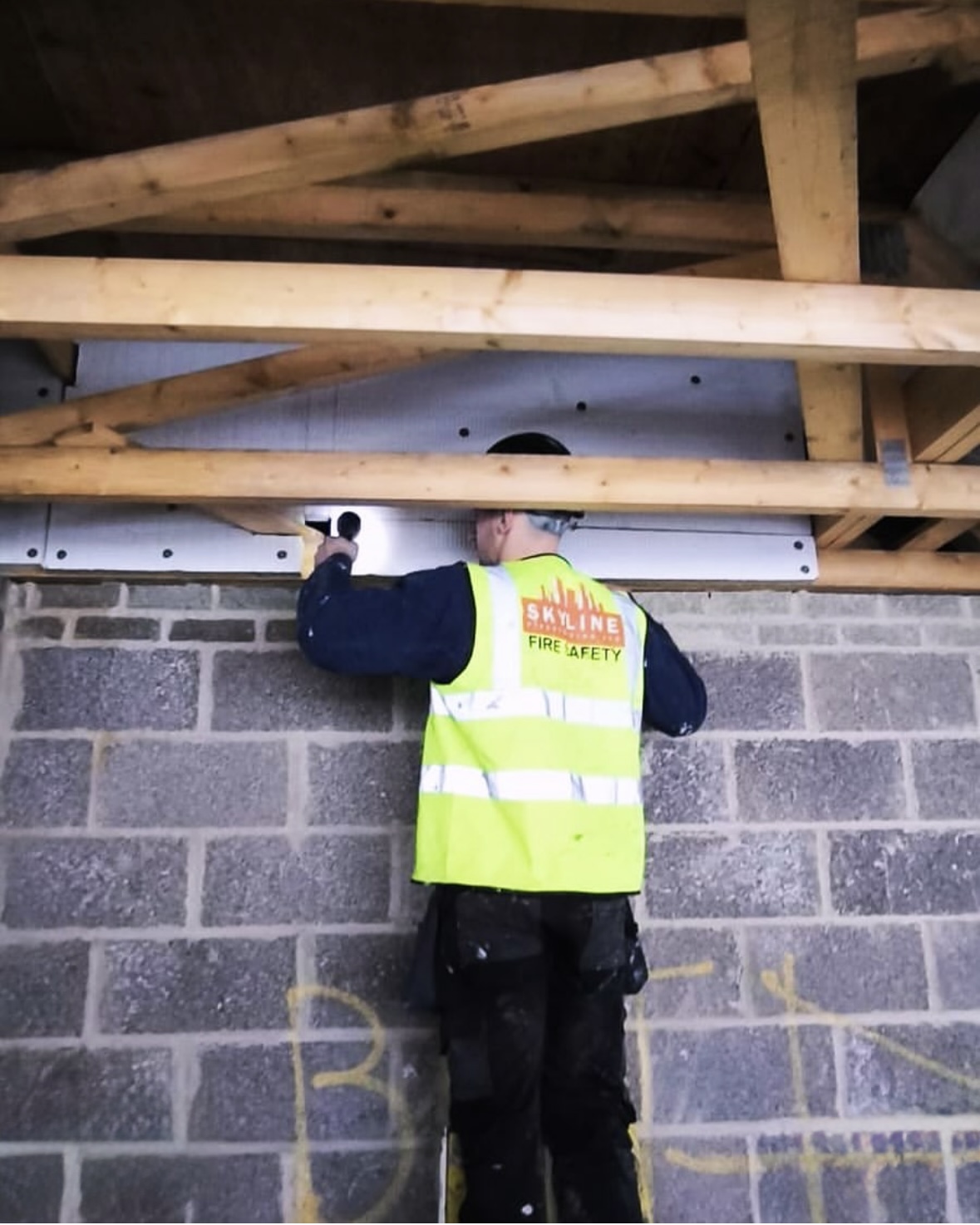
Most of what we install is covered over within days. That is exactly why we photograph every seal before, during and after installation. The record is the product as much as the work is.
The work behind the wall