Fire rated materials & the fire resistance rating. What the minutes mean.
A fire-resistance rating is a period in minutes that a construction element survived a standard test: commonly 30, 60 or 120 minutes, the periods Approved Document B and BS EN 13501-2 use. The letters around it — R, E and I — say what was being tested. This page decodes the ratings and why a rating belongs to a tested system rather than a product. Specify, install or sign off the wrong substitute and you void the evidence behind the seal, risking a handover problem.
BM TRADA Q-Mark certified — every seal we install is checked against its tested substrate, fixings and sealant, not sold on the spec alone.
What is a fire-resistance rating?
A fire-resistance rating is the period, in minutes, that a construction element survived a standard fire-resistance test: 30, 60 and 120 minutes are the common steps. The rating is earned against defined criteria — loadbearing capacity, integrity and insulation — and it describes performance under test conditions, not a promise about real time in a real fire.
The minutes come from the Building Regulations side: Approved Document B sets minimum periods for elements of structure by purpose group, basement depth, the height of the top storey and whether sprinklers are fitted. The classification language is the European BS EN 13501 series, which the guidance now uses in place of the older BS 476 national classes. So a specification reads as a code — EI 60, REI 120 — and every part of that code has a precise meaning. These ratings are the measurable core of What Is Passive Fire Protection?; the next section takes one code apart.
How do you read a fire-resistance rating?
Take a fire rating a specification actually uses — an EI rating such as EI 60 — and read it letter by letter, then minute by minute. The same method reads an REI rating on a loadbearing element. Once the code is decoded, every rated product page and test certificate reads the same way.
Schematic. The classification criteria are defined by the BS EN 13501 series; which combination a given element needs comes from the building's own fire strategy and Approved Document B's tables.
What are the fire-resistant materials?
Eight families of fire rated materials cover most of what a specification asks for, starting with fire rated board. Each one earns its rating as part of a tested system.
- 01
Fire rated board & batt
Fire rated board is high-density stone-wool batt, usually with an ablative coating, closing large openings where services cross walls and floors. The workhorse of penetration sealing. - 02
Intumescent collars & wraps
Expand when heated. Collars crush burning plastic pipes shut; wraps and mastics close the gaps services leave. Explained in the intumescent coatings service page. - 03
Fire-resistant sealants
Mastics and sealants rated for linear joints and small gaps, worked around cables and pipes as part of the tested detail they belong to. - 04
Cavity barriers
Stone-wool or intumescent barriers closing the concealed voids above ceilings and inside wall build-ups, so fire cannot travel past the compartment line unseen. - 05
Fire rated glass & glazing
Glazing systems rated E for fire integrity, or EI for integrity plus insulation. The frame, seals and fixing are part of the rating, never the pane alone. - 06
Fire rated ductwork & dampers
Fire resisting ductwork and fire dampers hold the line where ventilation must cross it: the damper closes automatically, the rated duct resists fire along its run. - 07
Concrete & masonry
Inherently fire resisting: they do not burn, and thickness plus cover protects the reinforcement. The rating belongs to the element as designed, and openings cut through it still need sealing. - 08
Rated enclosures & back boxes
Small but load-bearing details: rated enclosures and socket back-box covers stop everyday electrical penetrations from becoming holes in a fire-rated wall.
Why does the rating belong to the system?
No product is "60 minutes" on its own. The test that earns a rating burns a whole assembly: the wall or floor build-up, the opening size, the services passing through, the fixings, the thickness and the sealant details. Change any of them and the result no longer describes what was built. That is why tested systems are installed exactly as tested, why substituting one component for a cheaper equivalent voids the evidence behind the seal, and why third-party certification checks the install against the tested detail rather than the shopping list.
- The assembly is what was tested A collar rated with one pipe type and one wall build-up proves nothing about a different combination.
- Substitution voids the evidence Mixing components from different systems leaves a seal nobody has test data for, whatever each part's own rating says.
- The record proves the match Each Skyline seal is photographed and tagged with the tested system it was installed as, so the rating on paper matches the seal in the wall.
If your team specifies, installs or signs off fire-rated work, Skyline's Firestopping Education & CPD Training take these ratings further.
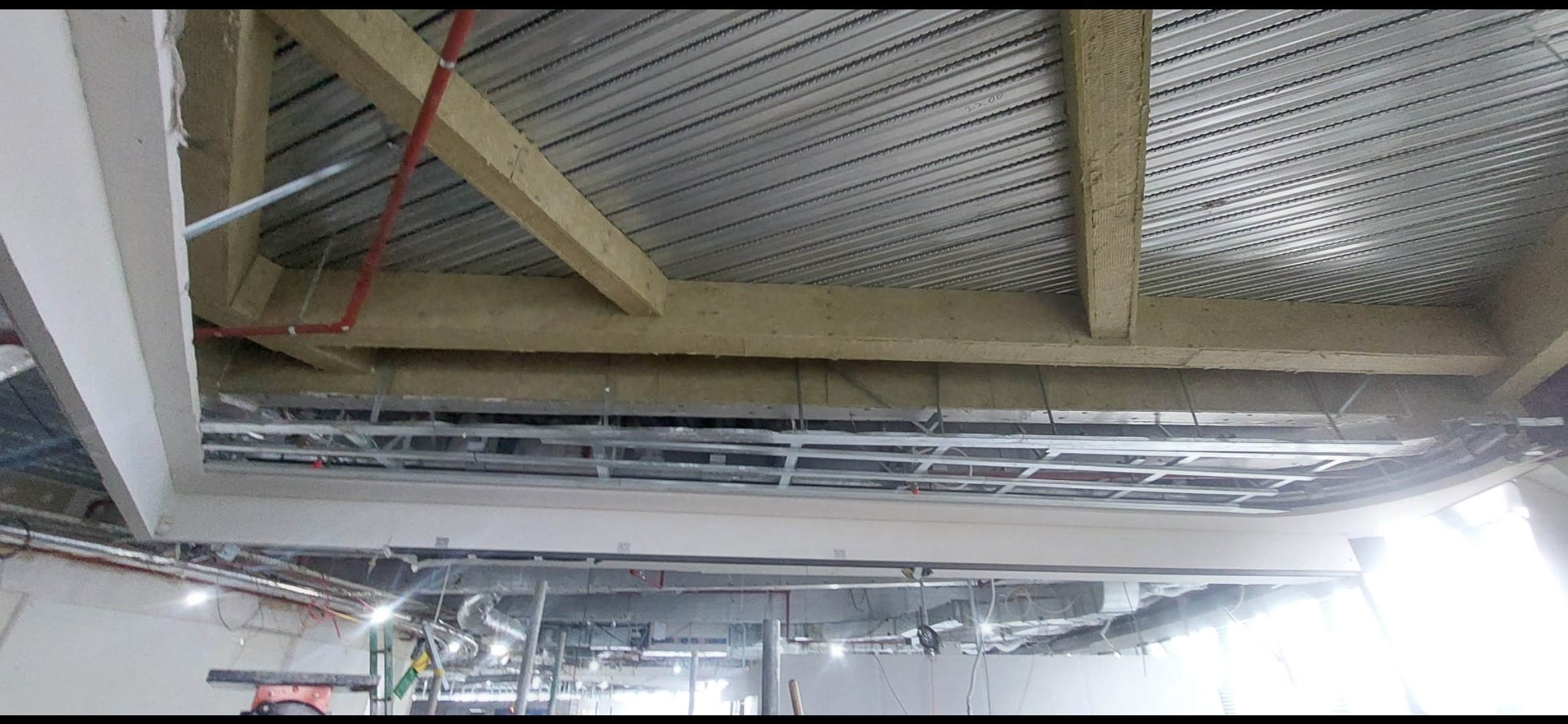 The system, in place
What does each classification promise?
| Classification | Reads as | What held, and for how long |
|---|---|---|
| E 30 | Integrity, 30 | No flames or hot gases passed through for 30 test minutes. |
| EI 30 | Integrity + insulation, 30 | Integrity held and the unexposed face stayed below temperature limits for 30 minutes. |
| EI 60 | Integrity + insulation, 60 | The same two criteria, held for 60 minutes. A common wall and seal spec. |
| REI 60 | Loadbearing + integrity + insulation, 60 | A structural element that kept carrying its load while holding fire back for 60 minutes. |
| REI 120 | Loadbearing + integrity + insulation, 120 | The heavy end: structure that held everything for 120 test minutes, asked of the most critical elements. |
Which classification a given element needs comes from the building's fire strategy and Approved Document B's tables. The tables set it by purpose group, height and basement depth, never by the material alone. The regulations side is covered in our Approved Document B explainer.
Materials and ratings, answered
What are fire resistant materials?
Materials chosen or treated to resist fire for a defined period: stone-wool boards and batts, intumescent collars, wraps and coatings, fire-resistant sealants, cavity barriers, fire rated glass, rated ductwork and dampers, and inherently resistant construction such as concrete and masonry. In a building they matter as parts of tested systems rather than as raw products. That's the practical core of Resources.
What is a fire resistance rating?
A period, in minutes, that an element survived a standard fire-resistance test: 30, 60 and 120 minutes are the common steps. The rating describes performance against defined criteria under test conditions, and the guidance is explicit that test minutes should not be confused with real time in a real fire. Buyers often compare rock wool and mineral wool products at this point; both are mineral fibre, and what matters is the tested system each belongs to.
What do R, E and I mean?
The European classification criteria under BS EN 13501: R is loadbearing capacity, E is integrity (no flames or hot gases pass), and I is insulation (the far face stays below temperature limits). They combine with minutes: EI 60 means integrity and insulation held for 60; REI 120 adds loadbearing capacity for 120. A common question is whether expandable foam is flammable: ordinary builders’ foam is not a tested firestopping product and has no rating of its own.
What is fire rated board?
Fire rated board is board manufactured to form part of fire-resisting construction. The common form is coated, high-density stone-wool batt, used to close large openings where services pass through walls and floors. Its rating in place depends on the tested system it is installed as: thickness, fixings, sealant and the services through it are all part of what was tested.
What is the fire rating of glass?
Fire rated glass carries the same E or EI classification as any other tested element: E for integrity alone, EI for integrity plus insulation. The fire rating of glass belongs to the glazing system as tested — pane, frame, seals and fixing together — never the glass alone, so a rated pane fitted into an unrated frame carries no rating in practice.
Is concrete fire resistant?
Concrete is inherently fire resisting: it does not burn, and it insulates the reinforcement inside it. The resistance of a concrete element depends on its thickness and cover, so ratings attach to the element as designed. Openings cut through it still need firestopping, because the rating belongs to the uninterrupted element.
What is an intumescent material?
A material that expands when heated. Collars crush burning plastic pipes shut, wraps and sealants close the gaps around services, and intumescent coatings protect structural steel by swelling into an insulating char. Each is rated as part of the tested system it belongs to.
What is a ductwork fire rating?
A ductwork fire rating is how long a run of ducting resists fire and smoke along its length, tested as part of the same system as the wall or floor it passes through. Fire dampers work alongside a duct fire rating rather than replacing it: the damper closes automatically at the opening, while the rated duct itself holds the line along its run.
What is Durasteel used for?
Durasteel is a proprietary mechanical fire-protection board — a fibre-reinforced cement core bonded to steel sheet — used where a rating has to survive impact and loading: fire resisting ductwork and smoke extract, riser and shaft linings, barriers and rated enclosures. Like any fire-rated material, it earns its rating only as installed in a tested system; the board, its fixings and the supporting framing are all part of what was tested.
Where can a site team learn to read these ratings?
Skyline's Firestopping Education & CPD Training teaches it: CPD presentations and toolbox talks that show specifiers, installers and sign-off teams how to read a classification like EI 60 or REI 120 correctly, on site, before it becomes a handover problem.
Page updated .