
Cavity barrier installation, certified and evidenced before cover-up
Cavity barrier installation with movement-tolerant barriers: tested systems installed exactly as tested and photographed before the cavity closes. Every one is tagged, geo-located and handed over in a complete evidence pack, for higher-risk buildings across Greater London and the M4 corridor.
Third-party certified — BM TRADA Q-Mark






Five years trading, 54 companies served. A certified team working on the buildings that can't afford to get it wrong, across Greater London and the M4 corridor.
Cavity barriers with no evidence trail stall sign-off at handover
On a higher-risk building the cavity closes over the work. A barrier that is missing, in the wrong state, or fitted with nothing to show for it stays hidden until a surveyor, an insurer or a gateway reviewer asks for the evidence. By then the wall is shut.
Nothing says which cavities were closed, in which state, or to which fire-resistance period. Without it, demonstrating compliance at handover gets much harder.
Once the cladding or ceiling is on, a barrier can't be seen or checked without opening the wall back up.
At Gateway 3, missing or inadequate evidence can delay or stop the completion certificate, whatever actually went in behind the facade.
Every cavity barrier installation ends with a complete evidence pack at handover
Send the cavity details for a quote. You get a cavity barrier installation by a BM TRADA Q-Mark certified team, tested systems installed exactly as tested and never mixed, and a complete evidence pack that shows what went in before anything closed over it.
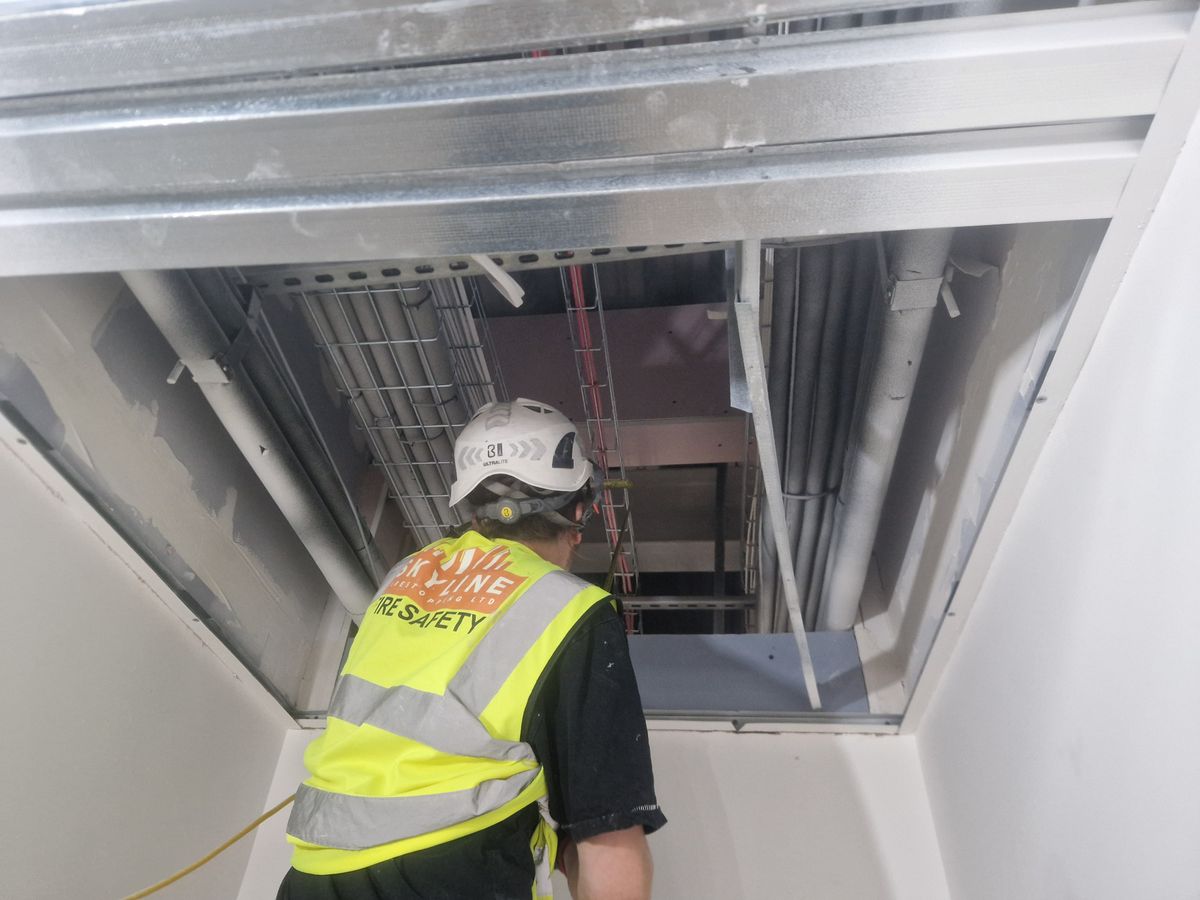
A cavity barrier closes a concealed cavity where it meets a compartment floor or wall, and around openings, in external wall cavities, separating walls, roof voids and ceiling voids.
The correct state for the cavity: open-state barriers that let a ventilated cavity breathe and close in a fire, or closed-state barriers that seal permanently. Fixed and installed exactly as the tested system specifies.
Tested systems installed exactly as tested and never mixed, to the manufacturer's tested detail for the fire-resistance period required. That means integrity and insulation, not a best guess on site.
Every barrier photographed, tagged and located before the cladding or ceiling closes the cavity, and handed over in a complete evidence pack kept for 15 years.
Read the video transcript
Being at Grenfell, the day it burned down, had quite a lasting impact on me, and that's why I ended up doing this. I used to install ventilation in high-rise buildings. I was on an install one day, and we were leaving Henley at about 6am, and we were driving into London, me and another guy. We were in the van, and as we came into London, we saw this huge amount of smoke coming out from the skyline, and we were both like, oh my god, it looks like there's a big fire. We turned on the radio to see if we could figure out what was happening, and the guy I was with started looking on his phone, and it was Grenfell. It was the same morning that Grenfell burned down. The job we were on was next door to Grenfell. Now, at the time, we didn't realise quite how serious it was, so we continued the journey. We came off the exit just before, and we carried on to work like normal. We were in the building adjacent, checking ventilation things in the bathrooms of these apartments, and the whole time we were there, every resident is asking us, what's going on? What's going on? And it was scary, man. We're just watching this building. It wasn't on fire. You couldn't see fire, but it was a serious amount of smoke, and there was a lot of police and ambulances and, obviously, fire engines. It had a significant impact on me, man, seeing how bad that was up close and personal. It's one thing seeing it on the news, and it's quite another being there. Anyway, I went home from work that day, and it was, you know, just one of those things, and then a couple of weeks later, a friend of mine said to me that he was going on a fire-stopping course, and did I want to come with him? And, obviously, that still being fresh in my mind, I was like, yeah, yeah, I do. Yeah, I want to come and learn that stuff, and that is how I got started in fire-stopping. I picked up the trade at that training course, and then I just went on all in with it, but I think that being at Grenfell the day it burned down had quite a lasting impact on me, and that's why I ended up doing this.
I was there the morning Grenfell burned. I couldn't help them. So now I make sure the work hidden behind the wall never fails the people who can't see it.
A cavity behind the cladding is exactly the hidden path a fire takes. Cavity barriers are the work no resident ever sees, so we evidence every one of them. Making our cities safer.
Open state cavity barriers installed and recorded by run and location
A cavity is the hidden path fire and smoke take through a building. Cavity barriers close that path where a cavity meets a compartment floor or wall, and around openings. On every cavity barrier installation, each barrier is photographed, tagged and geo-located into the evidence pack. The diagram shows where barriers sit in a typical external wall.
Barrier positions, states and fire-resistance periods on your project come from the fire strategy, the cavity details and the manufacturer's tested system.
- 1Horizontal cavity barrier — compartment floor lineCloses the cavity where each compartment floor meets the external wall, so fire can't track up the void from one storey to the next.
- 2Vertical cavity barrier — compartment wallCloses the cavity at a compartment wall, so fire can't spread sideways behind the facade between separated areas.
- 3Barrier to the opening revealSeals the cavity around a window or door opening.
- 4Open-state or closed-stateA ventilated rainscreen cavity takes an open-state barrier that breathes and closes in a fire; a sealed cavity takes a closed-state barrier. Each is fixed exactly as its tested system specifies.
Client feedback and enquiry
Skyline approached the work with enthusiasm and professionalism, working methodically through each defect to correct vulnerabilities.
Not sure your cavities are covered?
Send the cavity details for a cavity barrier installation quote, or talk to the team about a compartmentation survey.
Contact usThird-party certified cavity barrier work, by a team that has worked on The Gherkin and Olympic Park
Cavity barriers are hidden work, so what makes them defensible is tested systems, competent installation and a record of every barrier, backed by independent certification and a team that has done it on the buildings that can't get it wrong. Skyline installs to the BM TRADA Q-Mark. Tested systems are fitted exactly as tested and never substituted, evidenced before cover-up and retained for 15 years.
Named flagship projects:
We install the tested systems of the manufacturers whose details we work to — Rockwool, Nullifire, Quelfire, Protecta and Firefly — so the right system is specified fast and fitted without compromising the seal.
Open-state or closed-state?
Both close off the cavity where it meets fire-separating construction. They differ on whether the cavity needs to ventilate, and specifying the wrong one is how a barrier passes on paper but fails on site.
Open-state barrier
A ventilated cavity fire barrier lets a drained-and-ventilated rainscreen cavity breathe in normal use, then intumesces to close the void when a fire heats it.
- The usual choice behind drained-and-ventilated rainscreen cladding
- Keeps the cavity's designed airflow and drainage
- Closes on heat to hold the fire-resistance period
- Fixed with the brackets and restraint its tested system specifies
Closed-state barrier
Seals the cavity permanently where no ventilation is needed, forming a continuous compartment line straight away.
- For masonry and other cavities that don't need to breathe
- A continuous seal from the moment it is fitted
- Fitted to allow for movement as its tested system specifies
- Rated for the fire-resistance performance that location requires
The cavity is the path a fire takes
A cavity is a continuous void running behind a facade and through a building's voids. Left open at a compartment boundary, it lets fire and smoke travel unseen from one storey or one flat to the next. That hidden spread is what external-wall fires are known for. Cavity barriers close that path at every compartment line, and around every opening, so the compartmentation the fire strategy relies on actually holds.
The commercial risk is that cavity barriers are easy to miss and easy to get wrong, and the cavity closes over them. Once the cladding or ceiling is on, a missing or wrong-state barrier stays hidden until a surveyor, a fire engineer or a Building Safety Act gateway asks for the evidence. On a higher-risk building in England (at least 18 metres or 7 storeys, and containing at least two residential units or being a hospital or care home), that evidence has to carry into the golden thread and still stand up years later. Protection that can't be evidenced becomes remedial firestopping, re-opening walls that were signed off, rather than a clean handover.
That's why Skyline records every penetration, joint and cavity before it's covered, and hands over a complete evidence pack retained for 15 years. Cavity barriers belong to a continuous line of firestopping. Read how that line works in Firestopping and Fire Compartmentation Explained, or see the whole installation service on the Firestopping & Compartmentation page.
Cavity barriers, answered
What is a cavity barrier?
A cavity barrier is a fire-resisting component fitted inside a concealed cavity — an external wall void, a roof or ceiling void, or the gap in a separating wall — to close the hidden path that fire and smoke would otherwise take through the building. It does not replace a compartment wall or floor; it stops fire spreading through the cavity where it meets one.
Where are cavity barriers required?
Approved Document B sets out where, with some exceptions: typically at the junction of each compartment floor and the external wall, at each compartment wall, around openings such as windows and doors, and at the edges of the cavity. A ceiling cavity barrier closes the void above a suspended ceiling where it meets a compartment line, and ceiling void cavity barriers follow that line across every concealed ceiling space. The exact positions come from the building's fire strategy and the cavity details, not from a rule of thumb.
Open-state or closed-state — which do I need?
A drained-and-ventilated rainscreen cavity usually needs an open-state barrier that lets it breathe and closes on heat; a cavity that doesn't need to ventilate takes a closed-state barrier that seals permanently. The cavity detail and the fire strategy decide the state for each location.
Why photograph them before cover-up?
Because once the cladding or ceiling is on, a cavity barrier can't be seen or checked without opening the wall. We photograph, tag and locate every barrier before the cavity closes, so there's defensible evidence for the golden thread and nobody has to take it on trust.
Do you cover our project area?
Greater London and the Thames Valley / M4 corridor, including Reading, Henley, Newbury, Maidenhead, Windsor, Slough, Oxford, Swindon and Watford. If you sit at the edge of that area, call and ask.
Can you fix cavity barriers flagged on a survey?
Yes. Where a survey or a gateway review finds missing or wrong-state cavity barriers, we put them right with tested systems installed exactly as tested, each one photographed, tagged and geo-located. See Remedial Firestopping for how we close out defects found after the work is covered.
Read next
Request a quote for your cavity barrier installation
Send the cavity details for a quote, or book a survey if you are not sure what is behind the wall. Skyline is BM TRADA Q-Mark certified, with experience on The Gherkin, Olympic Park and Grosvenor Square.