

Resources

Firestopping guides, explainers & free downloads.

Every resource we publish, in one place: free guides, legislation explainers, and the definitions and fundamentals behind firestopping and current building-safety duties. All of it written by the team that installs and evidences the work.

Browse the free guides From Skyline's BM TRADA Q-Mark-certified installation team
Resources index

Resources from the people behind the wall

Start with the page that matches your question. Each one answers in plain English first, then goes as deep as the regulations do. Need it explained to your team on site? We run fire safety training and CPD toolbox talks too.

Watch

Firestopping, explained on camera

Short films from the team that installs and evidences the work. Every one carries its full transcript, so you can read it instead of watching.

Read the video transcript

Some people think that fire stopping is just filling holes and the truth is that it isn't. Hey guys, I'm Tom Ford, director here at Skyline Firestopping and I wanted to talk to you a little bit about what goes on behind the wall. Every building is divided up into what we call compartments and every pipe, cable and whatever else passing through these compartment or walls creates a weakness. If those openings or what we call penetrations aren't reinstated properly, then this means that the compartment no longer works and that essentially is what fire stopping is.

We make sure that the compartment lines stay intact when services or penetrations pass through. Fire stopping isn't there to stop fires, it's there to stop fires from spreading and those are two very different things. Fire compartmentation buys valuable time, it protects escape routes, it limits smoke spread and it protects residents and emergency services also. Purpose of compartmentation is actually to preserve the building exactly as it was designed.

Now there isn't just one fire stopping product, there's obviously a range of different products and manufacturers and different penetration types behave differently in a fire. For example, you have combustible and non-combustible, some pipes melt away, some stay in situ and transfer heat and when we talk about fire ratings we're not just talking about the products themselves, we're talking about the system, so the range of products which are used together in a system and that is where many mistakes can happen. Most fire stopping problems aren't actually installation problem, they can often start much further upstream, either planning that was left too late, poor design coordination, sometimes the wrong tested system for the actual situation, sometimes they can be incorrectly installed, sometimes it's a lack of quality QA and sometimes it's missing documentation. Most defects actually start weeks, sometimes months before the installation team actually even arrive on site.

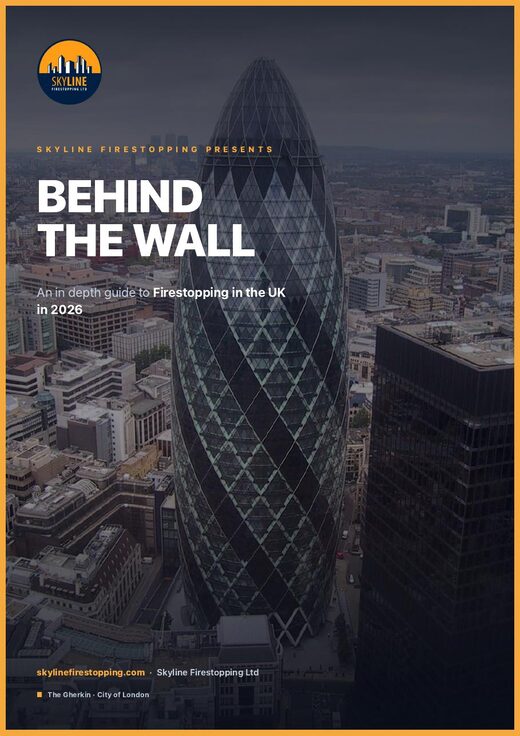
Creating safer buildings is actually everybody's responsibility, architects, M&E contractors, main contractors, consultants and like us, specialist installers. Not one of us can achieve full compliance alone, we have to work together as a team and my personal opinion is that that's the best way to look at it, it's a coordinated effort among everyone. We've created Behind the Wall to explain fire stopping in a bit more detail, it's free to download, if you're a developer, contractor, architect or even a building manager, it will help you understand what good fire stopping looks like. The link will be below, make sure you click it and don't forget to sign up to our email newsletter because we're creating more content just like this in an effort to make London's buildings safer.

Feel free to click the link below, download your copy and if you need anything further, please don't be afraid to reach out and contact us. Thanks guys!

Explainer · 4 min

What goes on behind the wall

Tom Ford on what firestopping actually is: how a building is divided into compartments, why every pipe and cable passing through a compartment wall is a weakness, and why most defects start upstream of the installation team.

Read the video transcript

Skyline Firestopping Ltd. Skyline Firestopping is a company that install passive fire protection. People are always asking me, like, is that like fire alarms and stuff like that? And I'm like, no, fire alarms, extinguishers and this stuff.

This is like active stuff. Passive stuff is installed in the building and stops the spread of fire in a building. So if you live in a block of flats, there's fire stopping in the building and it stops fire from passing from one room to another or one flat to another. And that's what I do.

I have a team of people and we install the best quality passive fire protection that you can get in the UK.

Definition · 40 sec

Passive fire protection, in plain English

The difference between passive and active fire protection, and what is built into a block of flats to stop fire passing from one home to another.

Read the video transcript

What would be your one to three best pieces of advice to do with fire stopping? Always check and check again. So, for example, if you're installing something or you've seen something that's been installed, always check that it is installed as per the manufacturer's guidelines because that's how it's tested. The second piece of advice is really, really stupid.

Don't prop fire doors open with fire extinguishers. I see it all the time. If it's a fire door, it's supposed to be closed. If it's open, it's not a fire door anymore, it's just a massive opening.

My number three piece of advice, which I've mentioned before, is just don't assume you know what the correct thing is here, what the correct thing is there. Always double check whether that's with a governing body or the manufacturer. Always double check. It's always worth doing.

Best practice · 54 sec

Three firestopping best-practice tips

Three rules from site: install exactly as tested, never defeat installed protection, and always double-check with the manufacturer or the governing body.

FAQ

Passive fire protection, answered

What is the difference between active and passive fire protection?

Active fire protection detects and responds to a fire: alarms, extinguishers, sprinklers and smoke vents. Passive fire protection is built into the structure. It contains fire and smoke within compartments using fire-resisting walls and floors, cavity barriers and firestopping, and it works without being triggered.

Is firestopping part of passive fire protection?

Yes. Firestopping is one of the core passive fire measures. It seals the gaps left where pipes, cables and ducts pass through fire-rated walls and floors, so each compartment keeps its fire resistance. Without it, compartmentation fails at exactly those openings.

Which buildings count as higher-risk under the Building Safety Act?

A higher-risk building is at least 18 metres or 7 storeys tall, whichever is reached first, and contains at least 2 residential units. That threshold triggers the Building Safety Regulator, Gateways 1 to 3 and the golden thread duty. During design and construction the same height test also captures hospitals and care homes.

Who is responsible for a building's passive fire protection?

In an occupied building, the Responsible Person under the Fire Safety Order must manage fire safety, and that includes the state of its compartmentation. During design and construction of a higher-risk building, the Building Safety Act places duties on named dutyholders, with the evidence held in the golden thread.

Where should I start if I cannot prove my building's firestopping?

Start with a compartmentation survey. A surveyor identifies every breach in the fire-rated walls, floors and risers, photographs it and records what needs to be done. The pages above explain the regulations behind that work. The survey page explains what the report itself contains.

What does a passive fire protection contractor do?

A specialist contractor surveys, installs, remediates and evidences the fire protection built into a building's fabric. That covers firestopping around service penetrations, fire-resisting walls and floors, cavity barriers and structural fire protection. Each installation is fitted to a tested system and recorded so it can be verified against Building Regulations and the golden thread.

Where these pages lead

From reading about it to proving it

When the question stops being about definitions and starts being about your building, talk to the team that installs and evidences the work.