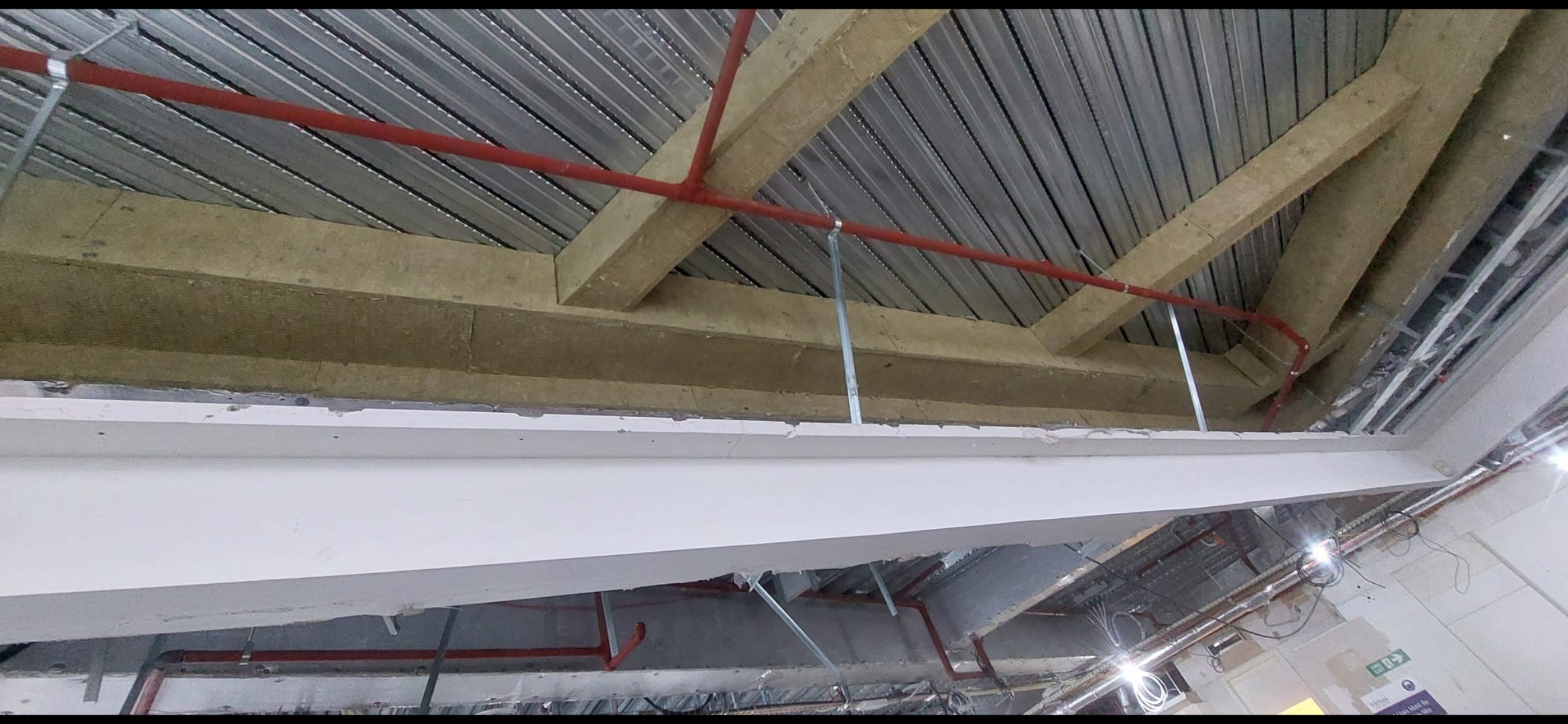
Steel protected to the fire-resistance period your fire strategy asks for, evidenced before cover-up and handed over with a complete evidence pack.
BM TRADA Q-Mark certified firestopping installer · Greater London & the M4 corridor
Send the steel schedule and the fire strategy. You get a thickness against every member, and a record that shows what actually went on.
Required periods taken from the strategy, not assumed from the storey. Transfer structure can require separate checking.
Every member's Hp/A read off the steel schedule, with the correct three or four-sided exposure for how it sits.
The system's assessment gives the thickness for that section factor and period. A slender beam and a heavy column differ.
Readings logged against the member reference before anything is boxed in or the ceiling closes the soffit.
Not a certificate saying the work was done. A member-by-member record of what was specified against what was measured on the steel.
Scroll for specified and measured thickness →
| Member | Element | Exposure | Section factor Hp/A | Period | Specified | Measured |
|---|---|---|---|---|---|---|
| UC 305×305×137 | Column | 4-sided | 76 m⁻¹ | 90 min | 1.10 mm | 1.18 mm |
| UB 457×191×67 | Beam | 3-sided | 172 m⁻¹ | 90 min | 2.35 mm | 2.44 mm |
| UB 610×229×101 | Beam | 3-sided | 137 m⁻¹ | 90 min | 1.86 mm | 1.91 mm |
| UC 203×203×46 | Column | 4-sided | 152 m⁻¹ | 60 min | 1.02 mm | 1.09 mm |
| SHS 200×200×10 | Bracing | 4-sided | 105 m⁻¹ | 60 min | 0.78 mm | 0.84 mm |
Their attention to detail and commitment to ensuring the project was completed on time and within budget was impressive.
Send the schedule and we will tell you what is specified, what is missing and where boarding is the better answer.
Request an intumescent quoteBoth achieve a fire-resistance period. They differ on appearance, programme position and how easily the finished work can be checked.
Sprayed or applied to the profile, then topcoated. The steelwork stays visible as steelwork.
Rigid boards fixed around the member to form a box. The steel is enclosed rather than coated.
Intumescent paint is a reactive coating: it stays thin at room temperature, then swells into an insulating char once a fire heats it, slowing a steel member's temperature rise so it holds its strength for the period the fire strategy asks for. As a member heats through a fire its strength falls away, and design works to a limiting temperature based on how hard that member is working. Unprotected, an exposed beam can reach that limit well inside the period the building has to stand up for. That is a structural fire-resistance question, separate from the compartmentation lines that stop a fire spreading between rooms and floors.
On site this goes by several names. Some ask for intumescent painting, because the material goes on like paint; others want intumescent spraying, or an intumescent paint contractor who can quote the whole frame. Search for intumescent painting contractors or steel fire protection specialists and you are usually looking for the same trade. The industry shorthand for the material itself is intumescents. Skyline records the work as Intumescent Coatings, because a tested system assessed under the EN 13381 series is what actually gets specified, applied and measured against each member, not a paint job.
The commercial risk is quieter. Coatings get priced off a schedule, and undocumented application creates risk once it is covered by ceilings. Then the fire engineer asks which system went on which member, and to what thickness. A delivery note is not an answer, and protection that cannot be evidenced becomes fire remedial works rather than a straightforward sign-off. On a higher-risk building that record has to survive into the golden thread and still hold up years later, long after the people who did the work have moved on.
There is no single answer. Thickness comes from each member's section factor and the required period, using the assessment for that system. A single figure quoted across a whole frame should be checked against the member-level take-off, unless the system's assessed specification is genuinely uniform for that project.
Often, yes. Shop application under controlled conditions takes the work off the critical path and gives a more consistent finish, with transport and erection damage made good on site. It needs agreeing early.
Greater London and the Thames Valley / M4 corridor, including Reading, Henley, Newbury, Maidenhead, Windsor, Slough, Oxford, Swindon and Watford. If you sit at the edge of that area, call and ask.
Send the schedule and the fire strategy. You get section factors, periods and a priced thickness against every member. Where boarding is the better answer, we will say so. BM TRADA Q-Mark certified · experience on The Gherkin, Grosvenor Square & Olympic Park.