Firestopping
Fire stopping installation certification: FIRAS vs IFC vs BM TRADA Q-Mark
Fire stopping installation certification compared: what FIRAS, IFC Certification and the BM TRADA Q-Mark scheme each audit, and whether the law requires one.
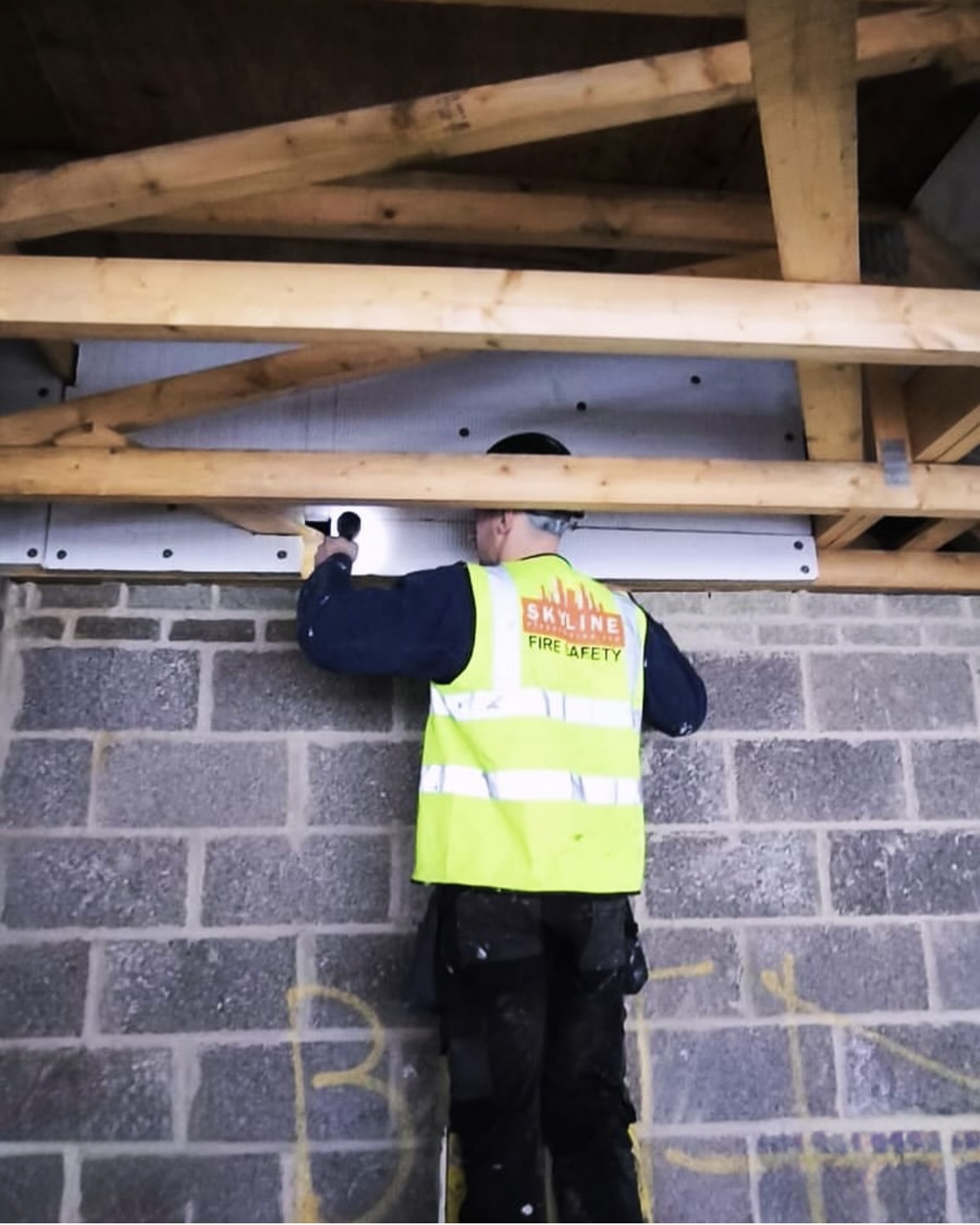
The three fire stopping installation certification schemes compared here are FIRAS, IFC Certification's installer schemes and the BM TRADA Q-Mark Fire Stopping Installation Scheme. FIRAS describes itself as a voluntary scheme. BM TRADA says membership is voluntary. FIRAS says it is not its role to inspect a member company's work on all projects undertaken, so ask for evidence for every seal.
This article sets the three schemes side by side from the scheme owners' own words, then gives you the questions that make any certificate mean something on your project.
What fire stopping installation certification is for
Approved Document B says that openings through a fire resisting element for pipes, ducts, conduits or cable should be as few as possible, as small as practicable, and fire-stopped. A fire-stop, in its definition, is a seal provided to close an imperfection of fit or design tolerance between elements or components, to restrict the spread of fire and smoke.
BM TRADA says its scheme is designed to ensure that fire stopping solutions are being fitted correctly, in accordance with the manufacturer's instructions. The FIRAS scheme promotes good practice for the installation and maintenance of passive fire protection products and requires the use of quality assurance methods in procedures, competence and documentation.
FIRAS
FIRAS is a voluntary, third party certification scheme for installation contractors of passive fire protection systems, accredited by UKAS to BS EN ISO/IEC 17065:2012. The FIRAS scheme was established in 1994. FIRAS certification can only be held by a company and not an individual installer.
FIRAS certified contractors are required to undergo a three-stage assessment process:
- Assessment of office management systems
- Assessment of workmanship of site for all trade disciplines for which certification is sought
- Competence assessment of supervisory and installation employees
One of its modules is fire rated penetration seals, fire-stopping and linear gap sealing; another is fire rated cavity barriers. Member companies are required to register all contracts on the FIRAS Maintenance Suite, which enables FIRAS inspectors to randomly select a project for a site surveillance audit.
The scheme is plain about the limit: it is not the role of FIRAS to inspect a member company's work on all projects undertaken, and on the sample projects audited only a selection of the work is reviewed at a snapshot in time.
IFC Certification (IFCC)
IFC Certification Ltd delivers independent, UKAS-accredited installer certification for fire protection systems. Its installer schemes include SDI 09, Penetration and Linear Gap Seals, and SDI 10, Cavity Barriers, alongside schemes for structural steel fire protection, partitions and dampers. Certification includes office audits, site inspections, competence assessments and ongoing surveillance, with annual audits after the initial assessment. Certified companies are listed in the IFCC Company Directory.
BM TRADA Q-Mark Fire Stopping Installation Scheme
BM TRADA is a UKAS-accredited certification body that provides personnel certification for fire stopping installation. The Q-Mark Fire Stopping Installation Scheme is based on training an individual who takes responsibility for the training and work carried out by a number of operatives. Membership is voluntary. BM TRADA publishes its certified companies so you can find a certified supplier.
Skyline holds BM TRADA Q-Mark certification and is progressing our ASFP membership application. On every firestopping installation Skyline fits tested systems, never substituted, and photographs every penetration, joint and cavity before cover-up, tagged and recorded as installed.
Is fire stopping installation certification legally required?
The scheme owners answer this themselves. FIRAS describes itself as a voluntary scheme. BM TRADA says membership is voluntary. BM TRADA also says that third-party certification is the accepted means of demonstrating competency.
Approved Document B, in its guidance on fire detection and alarm systems, describes third party certification schemes for fire protection products and related services as an effective means of providing assurances of quality, reliability and safety. Its fire-stopping provisions point to the Association for Specialist Fire Protection's guidance on the design, installation and maintenance of measures to contain fires or slow their spread.
Ask what the certificate proves about the people on site and what evidence will be left behind each seal.
What to check on any certificate
- The scheme and module: a penetration seals and linear gaps module, not a general fire protection badge.
- Who holds it: FIRAS certification can only be held by a company and not an individual installer. The Q-Mark scheme is based on training an individual who takes responsibility for the operatives' training and work. Ask who that person is on your job.
- The register entry: FIRAS Member Company Search, the IFCC Company Directory or BM TRADA's certified companies list.
- What the scheme audits: office systems, site workmanship, operative competence and surveillance visits, and how recently.
- What you will receive per seal: the tested system named, a photograph before cover-up and a tag, whichever scheme the installer belongs to.
For a plain comparison of what certification changes on site, read certified contractor versus generalist. If the building already has seals nobody can trace, an Intrusion Survey establishes what is actually there before any certificate is argued over.
Frequently asked questions
What is the difference between FIRAS and IFC certification?
FIRAS is a voluntary, third party certification scheme for installation contractors of passive fire protection systems. FIRAS certification can only be held by a company and not an individual installer. IFC Certification Ltd delivers independent, UKAS-accredited installer certification for fire protection systems; its schemes include SDI 09, Penetration and Linear Gap Seals, and certification includes office audits, site inspections, competence assessments and ongoing surveillance.
What does IFC certification mean for firestopping installers?
It means the installer has been assessed under an IFC Certification installer scheme, for firestopping that is SDI 09, Penetration and Linear Gap Seals, through an office audit, site inspection and competence review, and is then subject to annual audits and surveillance and listed in the IFCC Company Directory.
Will building control accept fire stopping work from a non-accredited contractor?
Approved Document B's fire-stopping provisions describe what should be fire-stopped and which tested systems and materials may be used, and point to the ASFP's guidance on design, installation and maintenance. Ask your building control body what evidence it wants for the fire-stopping on your project, and ask any installer, certified or not, for the tested system, a photograph before cover-up and a tag for every seal.
Which fire stopping companies in the UK are third-party accredited?
Each scheme publishes its own register: the FIRAS Member Company Search, the IFCC Company Directory and BM TRADA's list of certified companies. Skyline holds BM TRADA Q-Mark certification.